




Abstract
What Are AI Visibility Reports?
AI visibility reports show how your brand appears in AI-generated responses across AI systems. They track where your brand is being recommended, how competitors are positioned instead, and which prompts, sources, and AI systems are shaping visibility and influence.

AI search has turned brand visibility into something of an interpretation problem. When someone asks ChatGPT or Gemini for a recommendation, the AI agent pulls from its own content, third-party pages, reviews, and other sources it trusts. Then it compresses that material into a version of your business. That might be accurate, outdated or make a competitor look like the stronger choice.
91% of decision-makers have asked about AI visibility in the last year. AI visibility has moved beyond SEO curiosity into a C-suite reporting issue because it now shapes how buyers form shortlists. AI visibility reports can surface a lot of useful data to find gaps and opportunities. However, you need to know what to do with them. Which metrics do you track, and how can you interpret them? Importantly, where do you go from there?
What AI Visibility Reports Actually Show
AI visibility reports measure how your brand appears in AI-generated answers. They may cover brand mentions, citations, recommendation frequency, sentiment, competitive share, and source influence. You can also use them to track prompt-level performance across engines.
Most reports come from GEO or AEO platforms, which usually rely on controlled prompt testing. The platform asks a set of questions across models, records the answers, and scores your brand against competitors. That gives teams a starting point, but it can also create a false sense of clarity, since a sampled answer does not reflect how agents interact with your site.
It does not show which sources shape their understanding or whether that influence later turns into traffic, pipeline, or revenue. That means you should treat these reports as a monitoring system and directional evidence, not absolute truth. If you can’t connect visibility to sessions and revenue, you’re optimizing a scoreboard, not a channel.
The Two Layers of AI Visibility Reporting
Reports are now critical because they give marketing teams a view into a new channel that traditional analytics barely understands:
AI answers can influence the buyer before the click. If your brand is missing from the recommendation, you may never see the lost opportunity in your analytics.
Competitors can win category presence early. If AI systems repeatedly associate a competitor with stronger features or more trust, that position becomes harder to unseat.
Stakeholders need oversight of this new channel. Rankings and organic traffic do not show how AI engines shape the buyer’s shortlist before a visit.
Leadership needs to know whether AI visibility is improving and where competitors are gaining ground. The teams acting on the report need the diagnostic layer behind it, so they can see what is shaping the result and where to intervene.
Product Layers
Layer | Purpose | Includes |
Intelligence | Understand AI search performance | Prompt analytics, citation mapping, sentiment, competitive insights, agent signals |
Agent-Led Optimization | Improve AI search performance | Positioning fixes, recommendations, content generation, execution |
Revenue & Attribution | Measure business impact | Prompt attribution, conversions, pipeline, revenue, ROI |
Reporting Views
View | Audience | Focus |
Executive | Marketing & Growth Leadership | Market position, risks, pipeline, revenue impact |
Analyst | SEO, GEO, Content & Acquisition Teams | Performance drivers, gaps, sources, optimization opportunities |
Agency | Agencies & Multi-Brand Teams | Portfolio performance, benchmarking, client reporting |
Core Metrics to Track in AI Visibility Reports
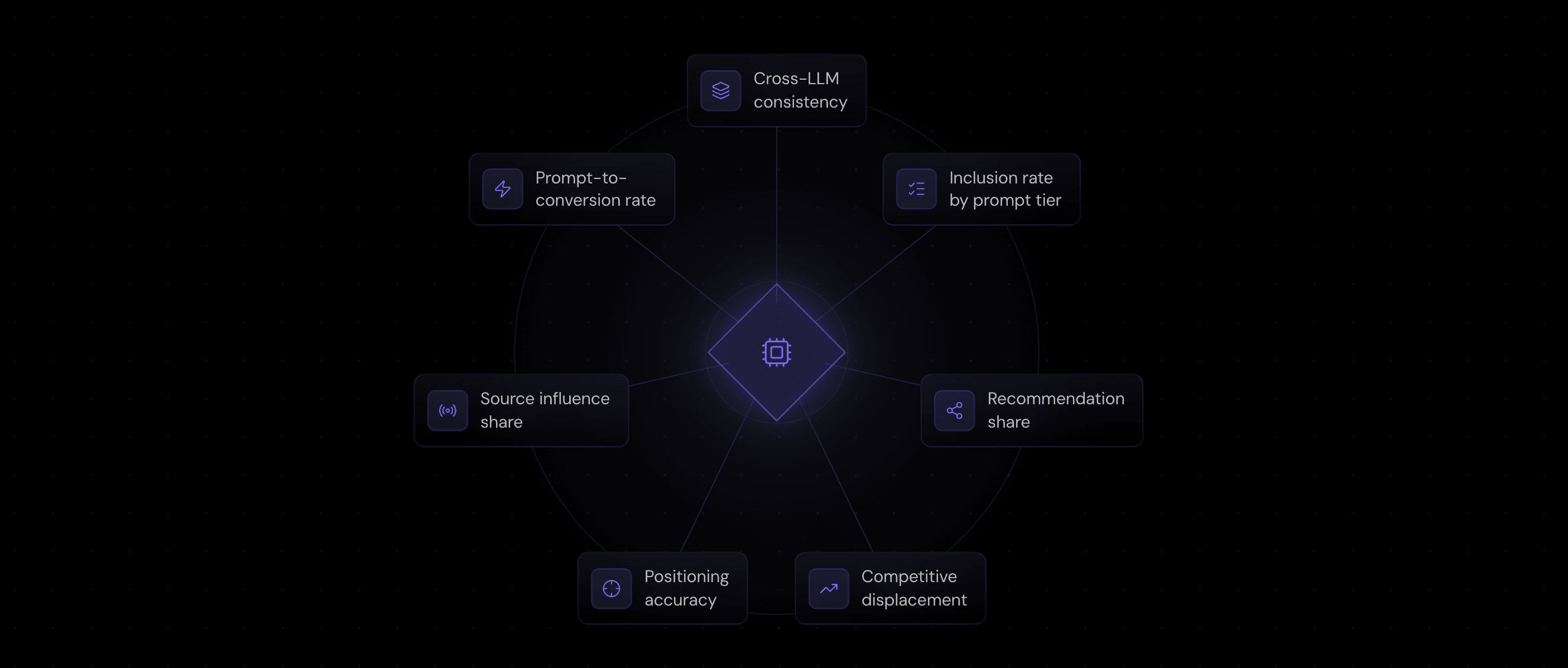
Inclusion rate by prompt tier – Tracks whether your brand appears across discovery, evaluation, and decision-stage prompts. The goal is not just to appear in broad educational answers. You want AI systems to recommend your brand when buyers compare options or ask for recommendations.
Recommendation share – Tracks how often AI systems recommend your brand as a preferred option. Some teams call this Share of Model. A mention does not equal a recommendation if the answer places your brand low in the response or behind several competitors.
Competitive displacement – Tracks prompts where your brand should reasonably appear, but a competitor shows up instead. These are often the prompts worth fixing first because they sit close to the buyer's choice.
Positioning accuracy – Measures whether AI systems describe your brand using the correct category, audience, features, pricing, and differentiators. Strong performance yields consistent, specific language that aligns with how you want buyers to evaluate your brand.
Source influence share – Identifies which domains, reviews, articles, listings, citations, and owned pages shape AI responses. Your owned content should shape the recommendation.
Prompt-to-conversion rate – Connects prompts to downstream visits, purchases, and other consumer actions. Without this layer, teams can track presence, but they cannot separate strategic visibility from background noise.
Cross-LLM consistency – Measures whether your positioning and recommendation strength hold across engines. Strong AI presence should not disappear when the buyer switches from ChatGPT to Gemini or Perplexity.
9 Best Practices for Analyzing AI Visibility Reports
1. Start With Prompt Intent Segmentation
Strong performance in broad informational prompts may not carry over to later buying-stage searches. You need a more fine-grained view of how your brand performs at each intent level. Start by grouping prompts into three tiers:
Discovery prompts capture early research, when the buyer is trying to understand the category and learn what solutions exist.
Evaluation prompts show that the buyer is comparing options or building a shortlist.
Decision prompts include “best,” “alternatives,” “versus,” pricing, and other terms associated with a buyer who is close to making a decision.
Once the prompt set is grouped, score visibility should be set for each tier separately. Look for gaps between discovery prompts and decision prompts. Decision-stage presence is the most urgent, as its absence can keep your brand off the buyer’s shortlist. This can be done manually if you start with a small, revenue-critical prompt set, but you will need a dedicated tool as you scale.
For example, a finance software company may appear consistently in informational prompts like “what is spend management software,” but disappear entirely in decision-stage prompts such as “best enterprise spend management platform.” That creates a false sense of performance because the prompts closest to revenue are those in which the brand is absent.
2. Separate Inclusion From Selection
A mention does not translate 1:1 into selection. AI responses often present your brand alongside other options, but that does not necessarily mean the answer steers the buyer toward you. You may be included in the answer while a competitor gets the stronger framing or top recommendation. For better analysis, you need to separate:
Inclusion rate measures how often your brand is mentioned at all.
Selection signals help you understand how often your brand shows up as a preferred or strongly recommended option.
Selection signals are harder to quantify because they come from the structure and language of the answer. Still, they are often more useful for understanding whether AI presence is actually helping you win attention.
To understand selection signals, look at the hierarchy of the response. Is your brand listed first or near the front of the pack? Does it get a detailed explanation? And is it described with clear recommendation language or a neutral/passing mention?
3. Analyze Positioning Consistency Across LLMs
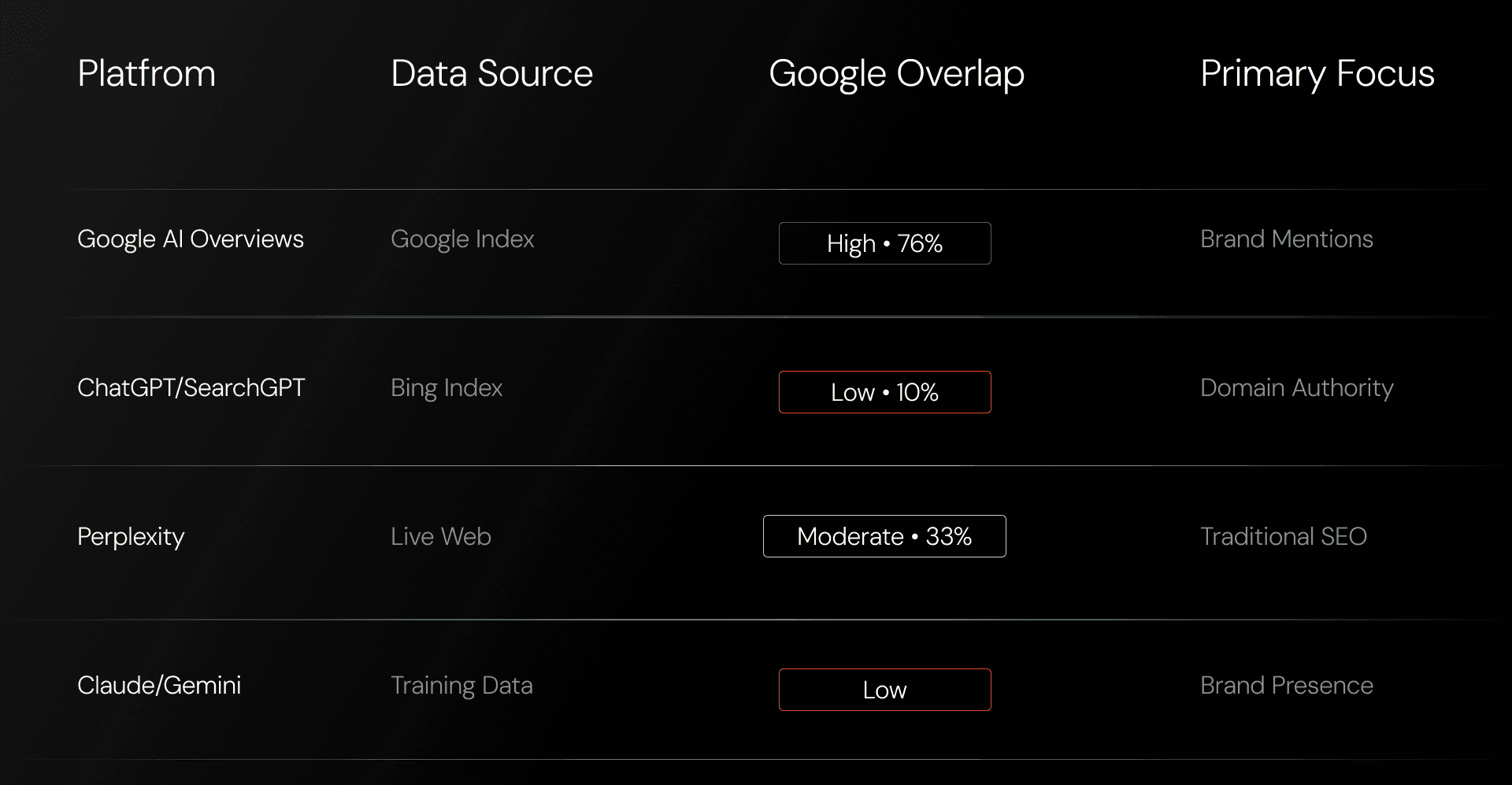
Each AI engine is built on its own proprietary retrieval, relevance, AI personalization, and answer-generation systems. Strong representation in ChatGPT does not automatically carry over to Gemini, Perplexity, or Google AI Overviews. If those systems interpret your brand differently, buyers using different AI tools may get a materially different picture of where your brand fits and who it should be compared against.
To analyze how consistently your brand is represented, compare the same high-value prompt set across each engine. If one model consistently describes your brand accurately while another omits key differentiators or recommends a competitor, you have a clear engine-specific gap to investigate. A small team can do this manually with a controlled prompt set, but recurring cross-engine monitoring needs a specialized automated tool.
4. Trace Every Recommendation Back to Its Source Layer
Every recommendation is shaped by an underlying source layer, even when citations aren’t exposed. You need insight into that sourcing layer because it helps explain how the model is arriving at its conclusions.
Analyze each mention through three questions:
Which domains are being cited or reflected?
Which content types are influencing the response?
And is your owned content part of the equation at all?
Your owned content should help shape the answer. Your product pages, comparison pages, docs, and category content should provide AI systems with clear, up-to-date information about what you do and where you fit. If third-party sources are doing most of that work, they may be controlling your positioning. Analyzing this is critical to protect your brand from potentially negative coverage that can build up over time.
For example, an eCommerce retailer may assume that their product pages define how they appear in prompts like “best running shoes for flat feet.” In reality, the shortlist is often shaped by third-party ecosystems: runner forums, editorial buying guides, retailer reviews, Reddit discussions, and comparison sites.
If those sources consistently favor a competitor or describe your products incorrectly, the model’s recommendation logic will reflect that pattern, even if your own pages are accurate. The real question in source-layer analysis becomes simple: are AI systems learning from you directly, or from everyone else talking about you? If it’s the latter, external reputation is shaping selection more than your owned positioning.
Note: Before diagnosing a source-layer problem, also check whether your owned content is eligible to be read in the first place. Check crawlability, noindex rules, snippet controls, structured data, and whether key content is accessible in text.
5. Analyze the Gap Between Recommendation and Traffic
A strong AI presence with weak traffic can mean two things: either AI systems mention your brand without positioning it as the preferred choice, or your analytics cannot properly attribute the influence. To understand the difference, compare changes in AI recommendation performance against the demand signals you already track:
Branded search lift
Direct traffic changes
Changes in high-intent page visits, such as pricing or product pages
Changes in lead volume, including form fills and demos
Shorter conversion paths
You can now compare AI recommendation trends against analytics and CRM data. For example, if decision-stage prompt presence improves and branded search or demo requests rise shortly afterward, that is worth investigating. But connecting a specific prompt or AI recommendation to revenue usually requires more advanced marketing attribution tooling.
6. Identify Prompt-Level Volatility
The same prompt can yield different recommendations over time, especially when the model draws on changing web sources and new content. That makes volatility worth tracking because it shows where your brand presence is unstable.
Look for prompts where your brand appears one week and disappears the next. Also, watch for cases where competitors keep rotating into the answer, or the model keeps changing how it describes what your brand does.
These prompts are an opportunity. If brands are rotating in and out, the category may still be unsettled, which means the model has not locked onto a stable set of trusted recommendations. Use those volatile prompts as your target list for content and source work.
7. Map Visibility to the Full Conversion Path
For agentic search presence to become useful, you need to connect it to the buyer’s purchasing journey. Start with your highest-value prompts and mark where your brand appears. Then, compare those appearances against answer quality, high-intent site behavior, CRM automation activity, and revenue data. The goal is to see which prompts feed different parts of the journey:
awareness → comparison → site engagement → lead capture → pipeline/revenue
From there, look for prompts with commercial movement. Those are the prompts worth prioritizing for content and positioning work. Limy is the only agentic marketing platform built around real agent behavior and revenue outcomes. It operates at the infrastructure layer, tracking what AI agents actually do on your site: which crawlers visit, what content they access, which prompts trigger discovery, and which interactions lead to revenue.
That infrastructure layer allows teams to connect AI search directly to the full conversion journey, enabling them to identify which prompts drive high-intent visits, which pages agents favor, and which optimizations increase recommendation frequency across LLMs.
Then, Limy also recommends the content, PR, technical, and structural changes most likely to improve AI recommendation performance. Every optimization is tracked against downstream commercial outcomes, turning AI search from a reporting layer into a measurable growth engine.
8. Rule Out Eligibility Blockers Before You Diagnose Visibility
Before diagnosing an AI visibility problem, confirm that your content is actually eligible for retrieval, interpretation, and surface by AI systems. Visibility analysis becomes unreliable if the underlying content cannot be properly accessed or understood. Check:
crawlability and indexability basics (robots.txt, noindex rules)
snippet and preview restrictions (nosnippet, max-snippet, data-nosnippet)
structured data validity and alignment with visible content
whether key content is accessible in clean text rather than hidden behind UX elements or JavaScript
rendering or accessibility issues that prevent extraction
9. Operationalize Reporting for Stakeholders
Establish a consistent reporting cadence, standardize KPI definitions across engines, and assign ownership of metrics such as recommendation share, competitive displacement, and prompt-to-conversion influence.
Teams should also maintain an audit trail of major content, PR, technical, and GEO changes so visibility shifts can be tied back to specific actions over time. The reporting layer becomes significantly more valuable when integrated with CRM, BI, and pipeline reporting systems, enabling stakeholders to measure how AI recommendations influence commercial outcomes.
Instead of relying on simulated prompts, Limy captures real agent behavior at the infrastructure layer: which prompts trigger discovery, how agents interpret your brand, which pages influence recommendations, and how those interactions progress from prompt to conversion. That allows teams to connect AI visibility directly to pipeline and revenue, not just mentions.
Make AI Visibility Measurable Past the Mention
AI visibility reports are more than just a map of where your brand appears in AI search. They are a starting point for understanding how AI systems interpret your business and which improvements can strengthen your position in the buyer journey.
Most teams still have incomplete data for this channel. AI search is new, and its influence does not translate well into traditional analytics. Without a way to connect those signals, teams can see pieces of the journey but not the full path from brand mention to revenue.
As the marketing stack for the agentic web, Limy gives teams a way to manage AI search beyond reporting. It tracks real agent behavior, links prompts to recommendations and site activity, and ranks opportunities by growth impact. With it, teams have a clearer way to prioritize the prompts and positioning gaps with the strongest business case.
Start now to find the AI search gaps with the clearest path to revenue and get ahead of competitors.
FAQs
What is the difference between AI visibility and traditional SEO metrics?
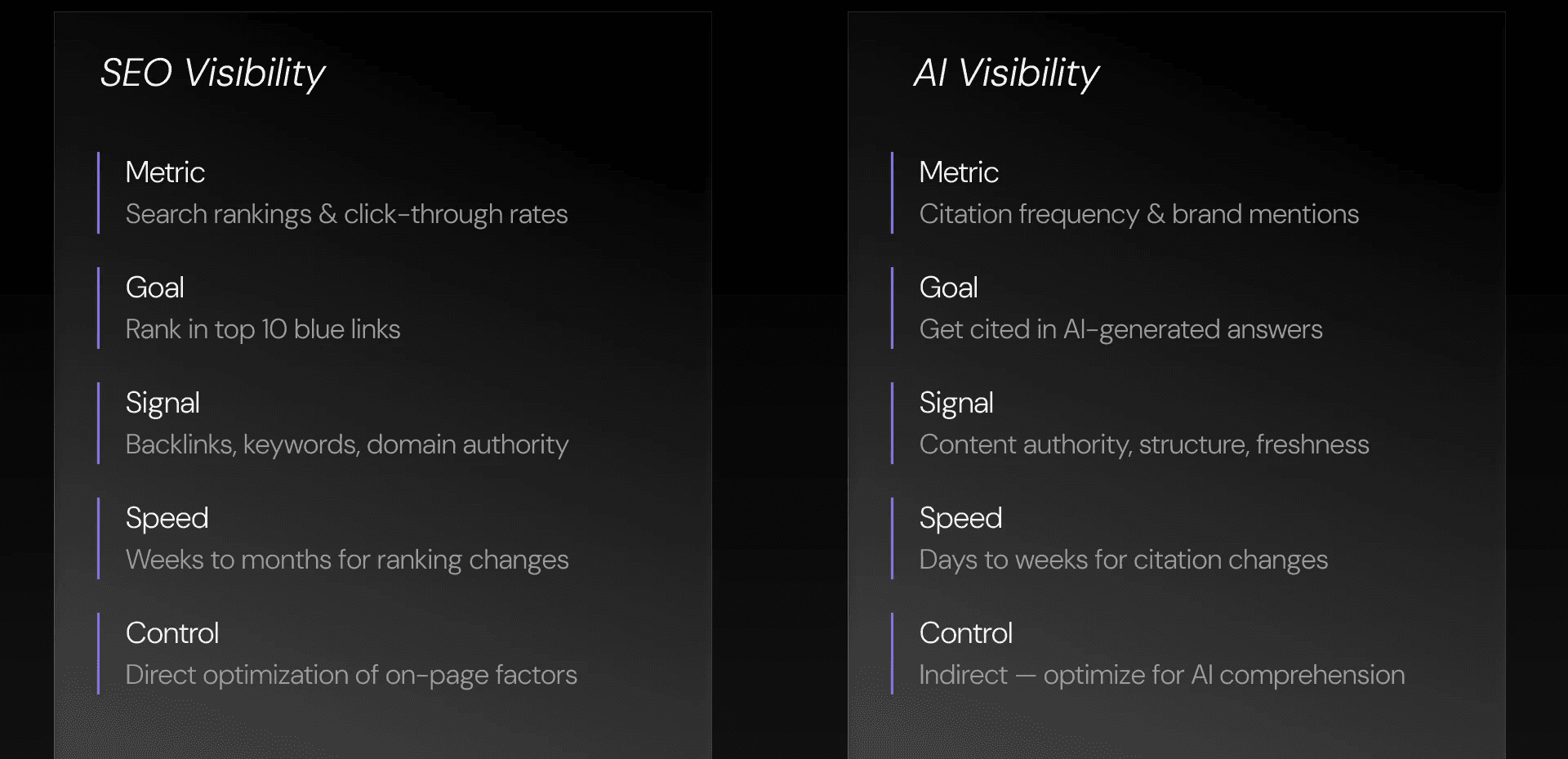
SEO tracks rankings and clicks. AI visibility tracks whether you are recommended inside the answer, using metrics like recommendation share and competitive displacement.
How often should I run AI visibility reports?
Ongoing, not one-off. The same prompt can return different recommendations week to week, so a consistent cadence beats any single snapshot.
What is a good benchmark for recommendation share in my industry?
There is no universal number. The benchmark that matters is your share against your named competitors on decision-stage prompts, and whether it is rising.
How do I know if my AI visibility problem is technical or content-related?
Rule out technical eligibility first: crawlability, noindex rules, structured data, and whether content is readable as plain text. If it can be read and you still lose recommendations, it is a content problem.
How long does it take to see results from AI visibility optimization?
It builds over time, not instantly, since it depends on engines picking up your content and source changes. Track your key prompts and watch the trend.
Which AI engines should I prioritize for monitoring?
The ones your buyers use, typically ChatGPT, Gemini, Perplexity, and Google AI Overviews. Track them separately, since strong presence in one does not carry to another.
What are the biggest mistakes teams make when analyzing AI visibility reports?
Treating sampled prompt tests as absolute truth, confusing a mention with a recommendation, judging one engine as if it speaks for all, and stopping at mentions without tying them to revenue.
Most Viewed Articles


