




Search hasn’t disappeared, but it has evolved. Ranking pages and measuring clicks is no longer enough to understand where prospective buyers are making decisions. Increasingly, buyer intent now happens directly within AI-generated answers, where users receive recommendations without ever visiting a website.
Between 30% and 50% of all search results now begin with AI Overviews, while overall website clicks have dropped by 30% despite rising search volume. That gap highlights a new challenge: traditional analytics tools cannot see where these decisions are happening.
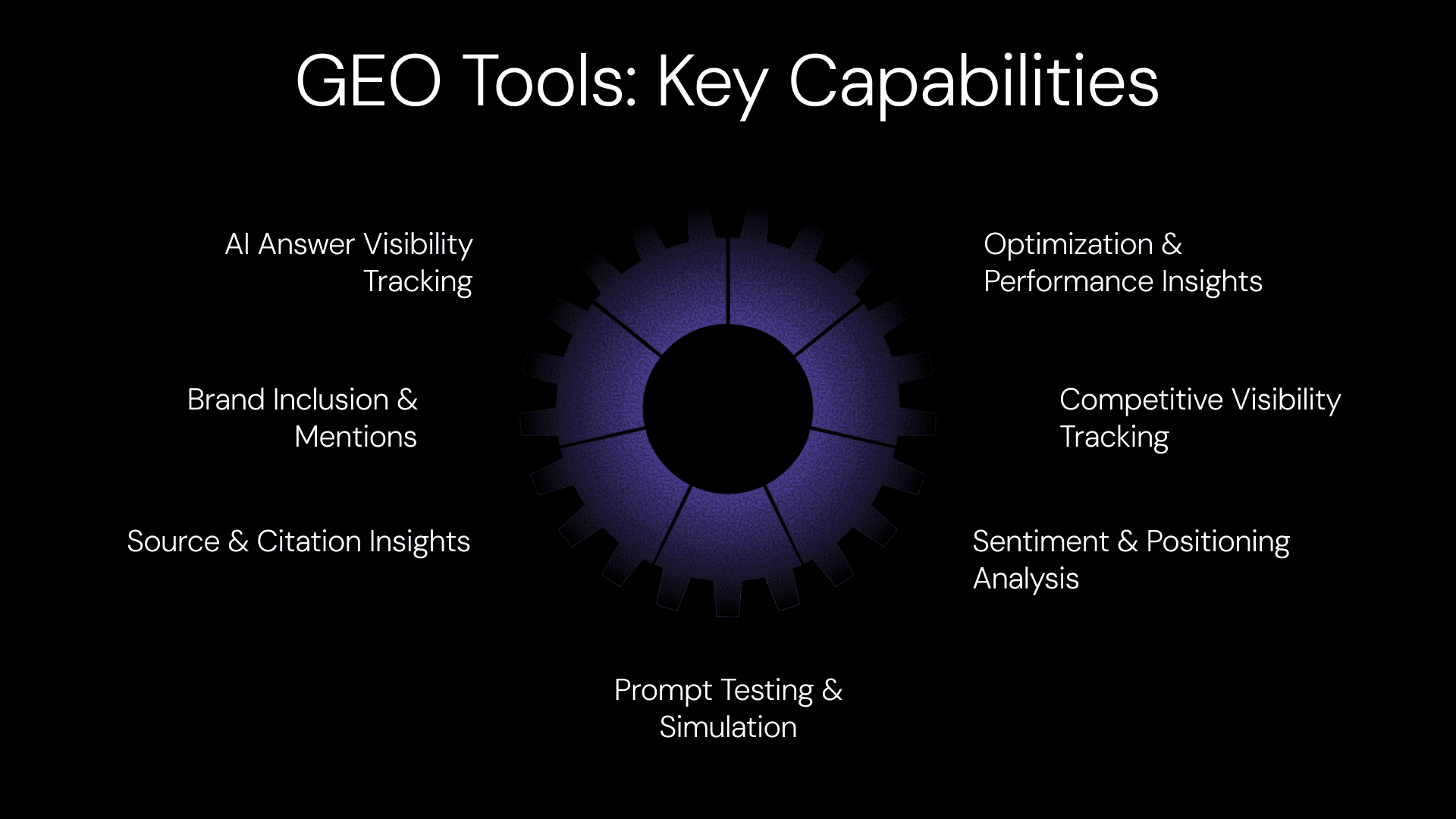
GEO tools show how your brand appears across AI-generated answers, where competitors are being recommended instead, and how visibility changes across prompts and platforms. They allow teams to understand performance beyond rankings and identify where they are being excluded from key decisions.
What Are Generative Engine Optimization (GEO) Tools?
Generative Engine Optimization (GEO) tools are platforms that track and analyze how brands appear in AI-generated responses across systems such as ChatGPT, Gemini, Perplexity, and AI Overviews. They run queries (or prompts), capture the responses, and show whether your brand is mentioned, how often it appears, and which competitors are recommended instead.
These tools give teams AI strategic visibility - widening the focus to include parts of the buyer journey that traditional analytics cannot measure. When a user asks an AI system for recommendations, the response often shapes the decision before any website visit happens.
GEO tools surface that layer by showing how your brand performs across prompts, topics, and AI platforms. Most GEO tools focus on visibility or content optimization. They show where you appear and where you are missing, and may provide automated recommendations based on the findings. However, they do not connect that presence to traffic, conversions, or revenue.
It’s also important to note that GEO does not replace SEO. Strong technical foundations and content quality still determine whether your brand is considered credible and eligible for recommendations from AI systems. GEO builds on that foundation, focusing on whether your brand is actually selected and recommended in generative responses.
Top Picks at a Glance
Best overall GEO platform: Limy
Best for AI visibility and revenue attribution: Limy
Best for content optimization for AI answers: Frase
Best for prompt/query tracking: Rankscale AI
Best all-in-one SEO + AI platform: Semrush AI Toolkit
Tool | Primary Use Case | Core Capability Focus | Data Depth | Attribution | Optimization Guidance | Best For |
Limy | Full GEO + attribution | Infrastructure-level tracking | Prompt → revenue | Yes (full funnel) | Strong (execution layer) | Enterprise, growth teams |
Rankscale AI | Prompt performance | Query tracking | Prompt analytics | No | Moderate | GEO specialists |
SE Visible | Visibility scoring | Prompt + sentiment insights | Score-based | No | Limited | Agencies |
WorkDuo.ai | AI monitoring | Brand presence tracking | Visibility | No | Limited | SMBs |
Hall | AI brand tracking | Monitoring | Mentions | No | Limited | Early-stage teams |
Writesonic | Content optimization | AI-ready content creation | Content performance | No | Strong | Content teams |
Frase | Answer optimization | Content structuring | SERP + AI overlap | No | Strong | SEO teams |
Surfer SEO | Content scoring | Optimization workflows | Content signals | No | Strong | SEO-led teams |
AthenaHQ | GEO visibility | Prompt tracking | Prompt-level | No | Moderate | Early adopters |
LLMrefs | Prompt tracking | Query intelligence | Prompt data | No | Limited | Analysts |
Semrush AI Toolkit | Hybrid SEO + AI | Visibility + SEO data | Combined | Limited | Strong | Existing Semrush users |
SEOTalos | AI keyword tracking | Prompt monitoring | Query-level | No | Limited | Niche users |
Top 12 Generative Engine Optimization (GEO) Tools [By Category]
Complete AI Visibility and Analytics Suite
These platforms aim to cover the full AI discovery lifecycle. They combine visibility monitoring with deeper analytics, often including traffic insights, behavioral data, and (in more advanced cases) attribution and execution. This category is closest to a true system of record for agentic discovery.
Limy
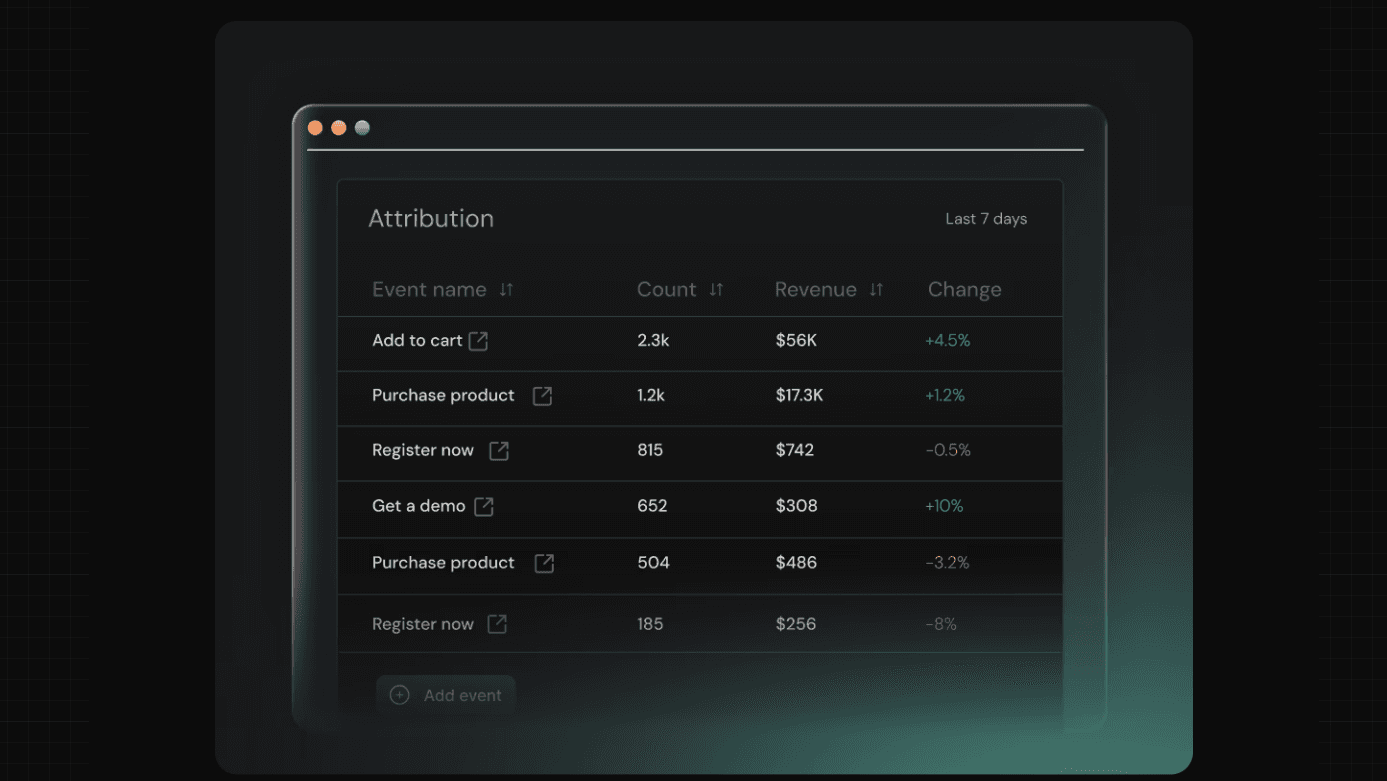
Limy operates at a fundamentally different layer from most GEO tools. It is a marketing stack for the agentic web and the attribution layer for generative discovery. It operates at the infrastructure level, capturing real AI agent behavior on your site, showing which agents visit, what content they extract, and which prompts trigger that activity. It connects those interactions to downstream conversions through prompt-to-conversion marketing attribution, tracking the full path from AI recommendation to revenue.
It also includes cross-LLM visibility tracking, AI referral traffic analytics, citation gap detection, and a recommendations engine that identifies and executes high-impact optimizations, with every change tied back to measurable outcomes.
Best for: Teams that need to turn AI search into a measurable revenue channel, not just track visibility.
Review: “We went from minimal presence to second place in one month.”
Rankscale AI
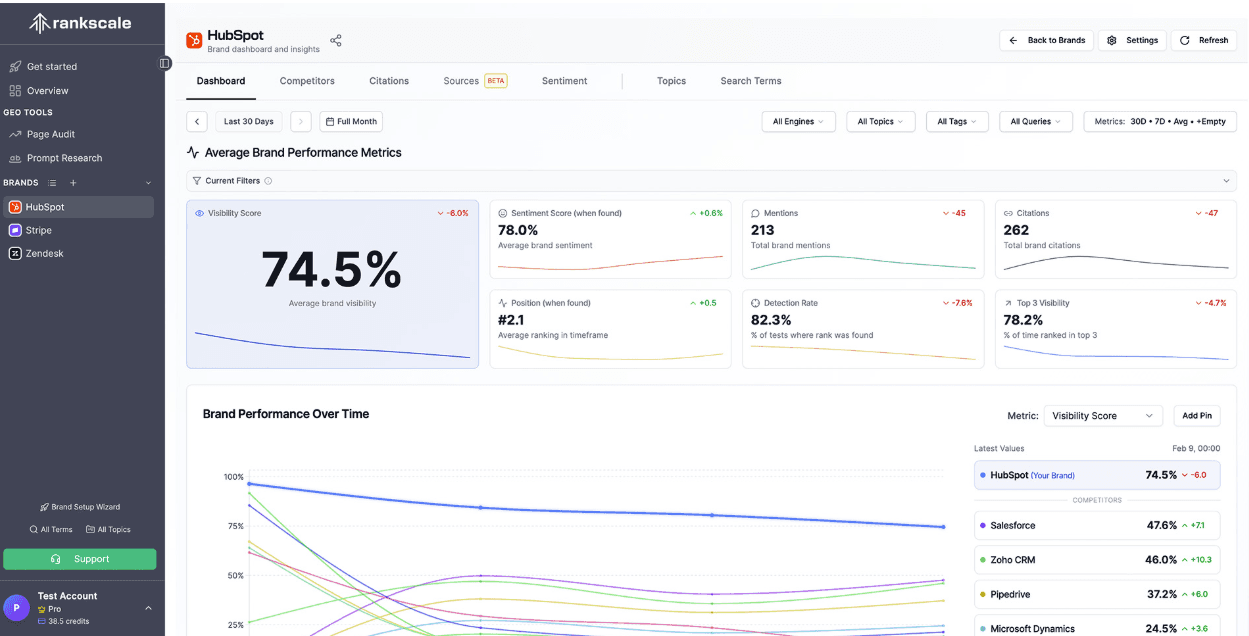
Rankscale is a full GEO visibility platform. It runs queries across 17+ AI engines and builds a structured dataset that shows how your brand appears in generated answers. At the core is an AI Rank Tracker that measures your brand’s position in responses, tracks mention frequency, and calculates visibility metrics such as share of voice and sentiment across engines.
It also includes citation analysis, showing which domains and URLs are being referenced in answers and how often AI systems use your content as a source. There is also competitor benchmarking and AI readiness auditing, which evaluates site structure, crawlability, and authority signals.
The limitation is that everything happens at the visibility and response layer. It shows where you appear and how you rank, but it does not connect that to user behavior, traffic, or revenue.
Best for: Teams that need multi-engine AI visibility tracking with ranking, citation, and competitor analysis
Review: “Rankscale offers the most flexible LLM Rank Tracking on the market.”
AI Visibility & Brand Monitoring Platforms
These tools focus specifically on tracking where and how your brand appears in AI-generated answers. They measure mentions and share of voice across prompts and platforms, but typically stop at reporting. They are useful for understanding visibility gaps, not for acting on them or tying them to business outcomes.
SE Visible
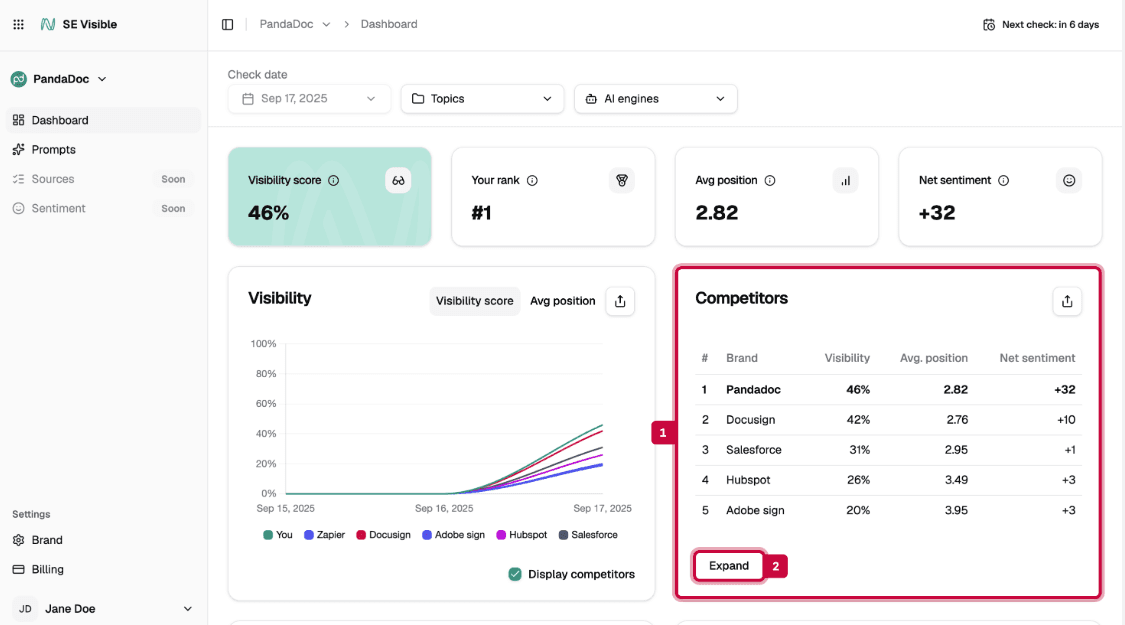
SE Visible aggregates prompt-level outputs into standardized performance scores. It runs prompts across multiple LLMs to extract mentions and sentiment, then converts them into visibility and sentiment scores per brand. The platform also provides prompt and topic breakdowns behind those scores, so users can drill into which queries are driving performance changes.
A distinguishing feature is its multi-client reporting layer, which allows agencies to track multiple brands and generate consistent reporting across them. It does not provide raw prompt-experimentation tools or attribution workflows, so it’s mostly a reporting interface built on top of collected LLM data.
Best for: Agencies that need standardized reporting across multiple brands
Review: “I use SE Ranking to track keyword rankings and see how our content is performing in search. I also run site audits and check competitor visibility when needed. It helps me stay aware of what's working without getting too technical.”
WorkDuo.ai
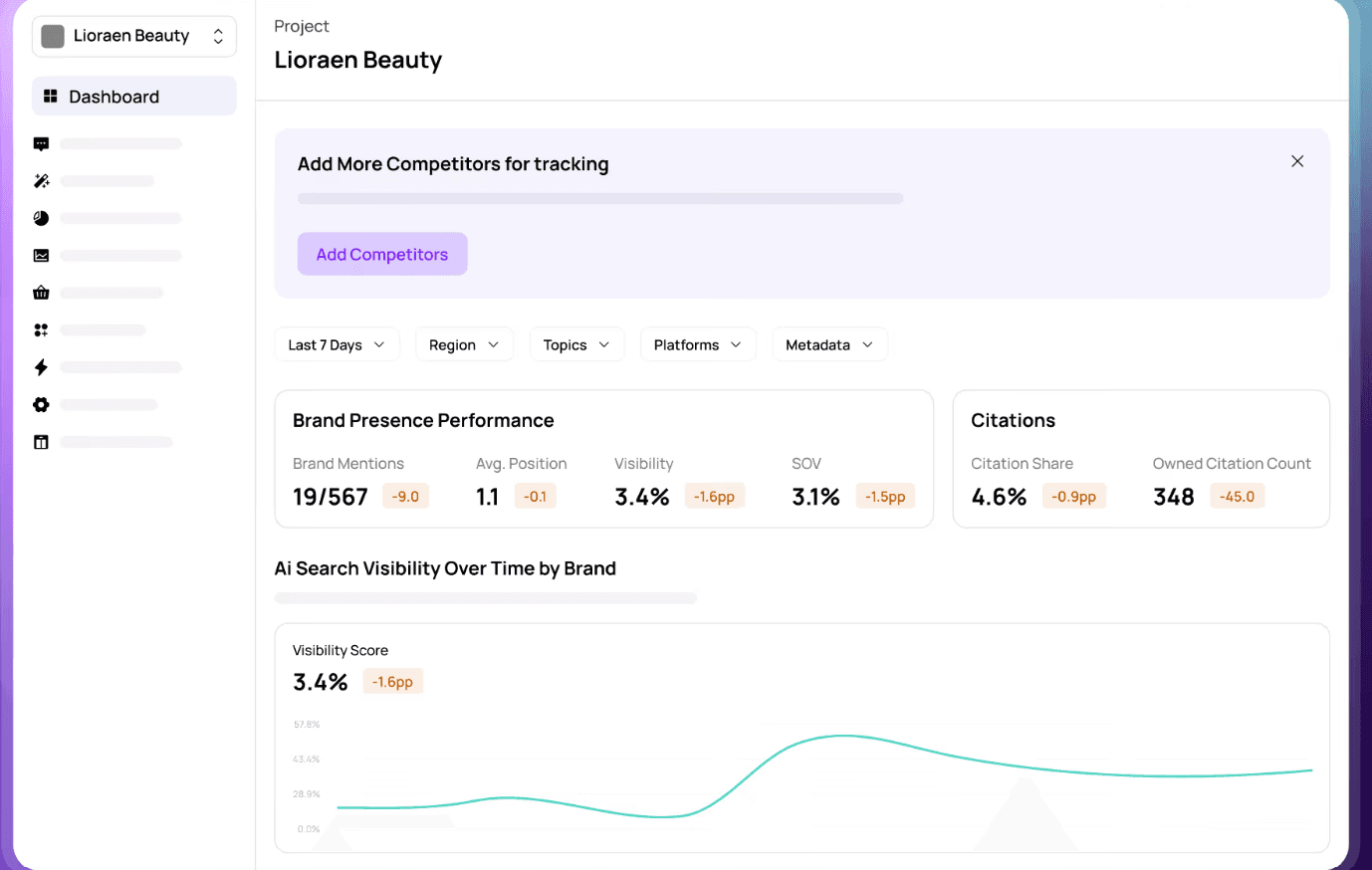
WorkDuo.ai is a prompt-tracking and response-monitoring tool with a simplified interface. Users define a set of prompts (or prompt categories), and the platform runs them across supported LLMs to track whether a brand appears in the output.
It stores responses over time and provides historical comparison, allowing teams to see how inclusion changes across different stages of the product lifecycle or after content updates and market shifts. It also includes basic competitor overlays, showing which brands are appearing instead when yours does not. Unlike more advanced platforms, it does not include topic clustering, large-scale prompt expansion, or source-level analysis.
Best for: Teams monitoring a defined set of high-priority prompts
Hall
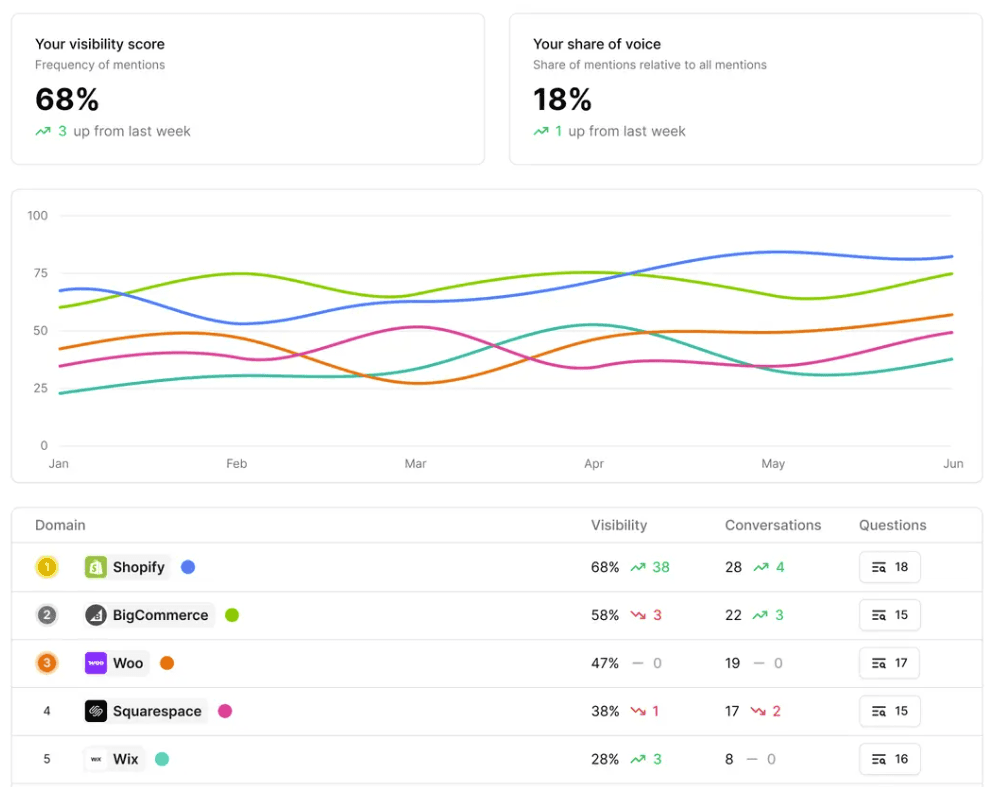
Hall is closer to a manual prompt-tracking and response inspection tool than to a full monitoring platform. It allows users to run prompts across selected models and store the outputs for review and comparison over time.
The core functionality is in response inspection: Users can see exactly how answers are generated and which brands are included. They can also spot how wording changes between models or prompt variations. This makes it useful for qualitative analysis, especially for understanding how LLMs construct responses. It does not attempt to build large-scale datasets, generate topic clusters, or calculate share-of-voice metrics. There is also no automated gap detection or benchmarking layer.
Best for: Teams analyzing individual prompts and understanding response construction
Review: “As an agency, I love that I can add as many projects as I like, allowing me to use my credits flexibly. I also love the entity mapping, which allows for an additional layer of refinement for AI mentions tracking, especially for DTC brand tracking and/or for clients with multiple brand entities.”
GEO Content Optimization Platforms
These platforms provide recommendations on content production and structure aligned with GEO best practices to increase the likelihood that AI systems select your content during answer generation. Their value depends on whether teams can connect content changes to downstream visibility elsewhere.
Writesonic AI
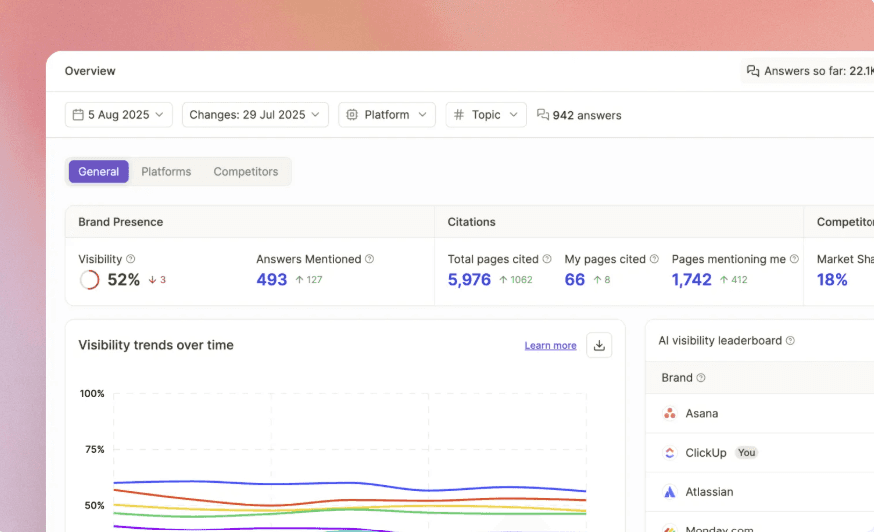
Writesonic is a content production system with AI-search-aware workflows, particularly through its “AI Article Writer” and content templates designed around answer-first formatting. It allows teams to generate long-form content that mirrors how LLMs construct responses, including structured sections and direct answers. It also includes an “AI crawler” view that shows whether its own system can parse and interpret content, which is a proxy for AI readability. However, this is not true visibility tracking across external LLMs. The platform is ideal for the scale of production, not for validating impact.
Best for: Teams producing large volumes of structured, AI-readable content
Review: “Excellent UI, great AI integration to help you actually get work done. But what sets them apart is their deep knowledge of SEO and Content Marketing.”
Frase
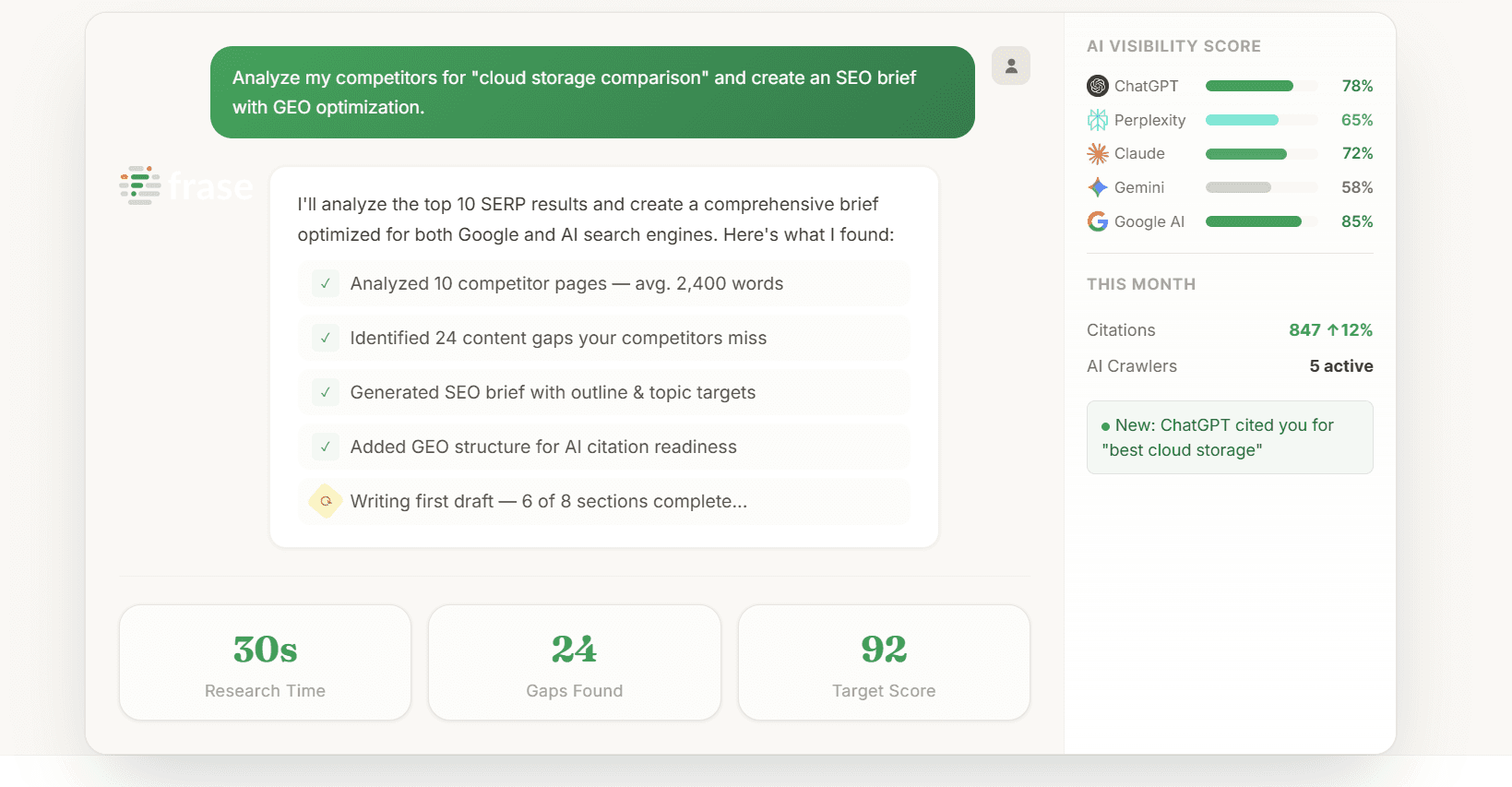
Frase’s core GEO services are content briefing and optimization built on top of SERP data. It analyzes search results to surface the questions people ask and the way top-ranking pages structure their answers. That information is used to guide how content should be written, with an emphasis on clarity, coverage, and direct response.
Pages optimized in Frase are easier for AI systems to interpret and reuse because the information is explicit and well-organized. However, the platform does not show whether that content is actually used in AI-generated answers or how it performs beyond the page itself.
Best for: Teams restructuring content around question-answer formats
Review: “I use Frase.io's MCP in Claude to audit AI visibility, spot content opportunities, and ensure my site's health is good. The MCP is so easy to use and is a game changer because it brings insights directly into my workflow without needing to toggle between tabs.”
Surfer SEO
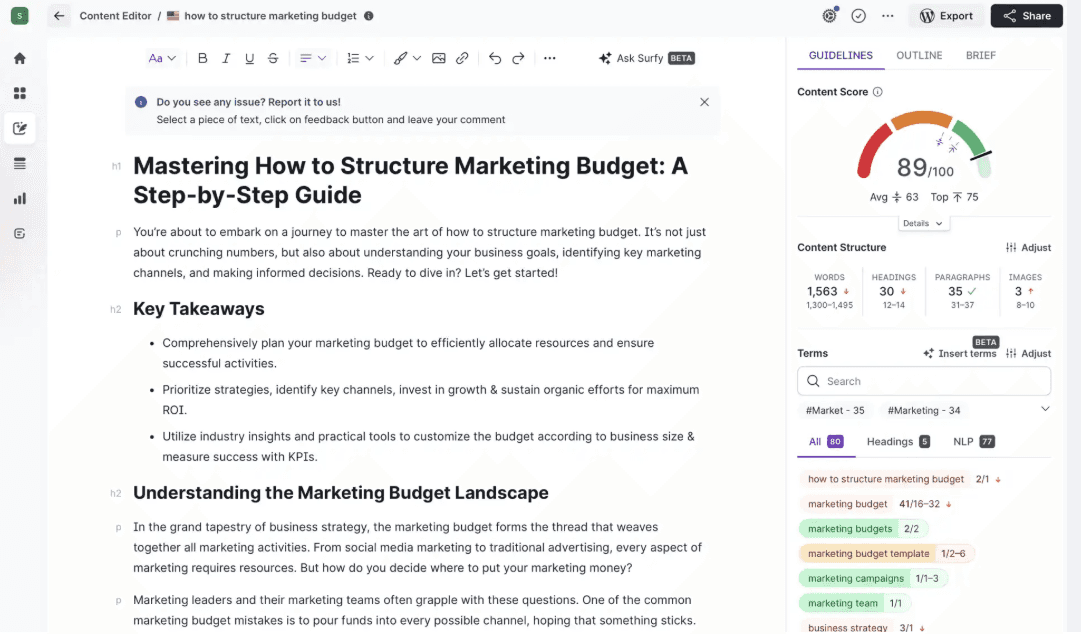
Surfer SEO is built around data-driven content scoring, using correlations from top-ranking pages to define what “complete” content looks like for a given query. When you input a keyword, it generates a Content Editor that breaks down recommended terms, heading structure, word count ranges, and topic coverage based on what already ranks.
The core workflow is iterative. As you write, Surfer scores the content in real time, showing how closely it matches the patterns found across high-performing pages. It also includes an audit feature that compares existing pages against competitors. However, the tool doesn’t model how AI systems assemble answers. There is no visibility into LLM outputs or prompt tracking.
Best for: Teams strengthening content authority and coverage
Review: “I really like the Content Editor, which makes it much easier to organize and structure the content I'm working on. The auto-optimize feature is a great backup after I've manually optimized as much as possible.”
AthenaHQ
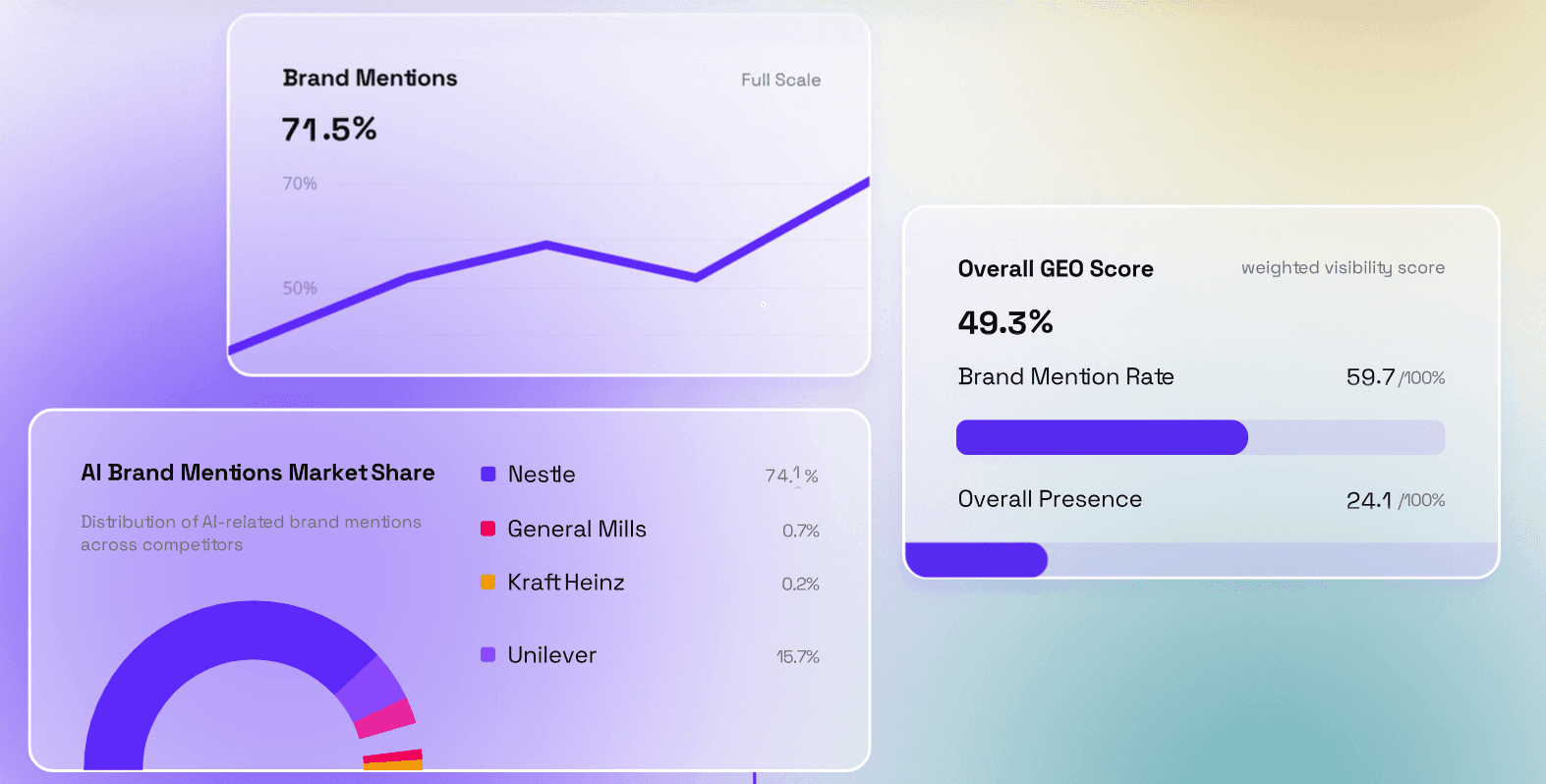
AthenaHQ focuses on tracking brand visibility across AI-generated answers at the prompt level, with a strong emphasis on ongoing monitoring. Teams can define prompt sets tied to their category, then run those queries across models like ChatGPT and Gemini to capture how responses evolve.
The platform provides response-level visibility into outputs, showing brand mentions, where they appear in the answer, and which competitors are showing alongside them. It also tracks frequency of inclusion across prompts and enables ongoing tracking of the same prompt sets, so teams can measure whether changes in content or strategy lead to improved inclusion over time. However, there’s no built-in attribution for traffic or revenue, which makes it harder for teams to directly connect AI visibility improvements to outcomes such as reducing customer acquisition costs.
Best for: Teams identifying content gaps tied to AI visibility
Review: “AthenaHQ's regional segmentation was a differentiator for us. We discovered that our AI visibility in the Southeast was half what it was on the West Coast, even though our store density is similar.”
Prompt & Query Intelligence Tools
This category is closest to “keyword tracking” for AI search. These tools are built around monitoring how specific prompts behave across LLMs, rather than tracking full brand visibility or performance across journeys.
LLMrefs
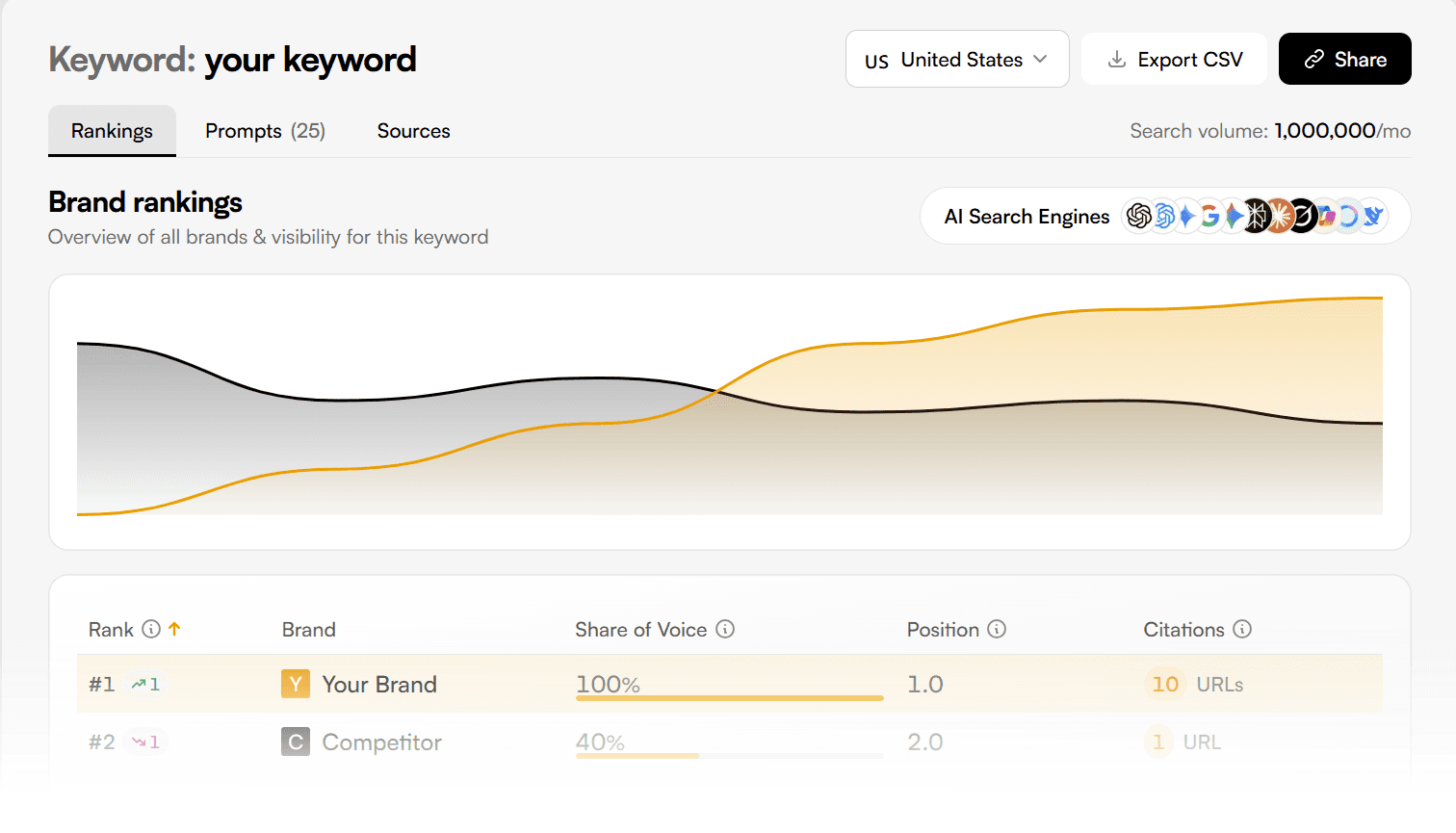
LLMrefs is an AI search visibility tracker for keyword-level monitoring. You import the keywords you want to own, and the platform automatically generates fan-out prompts based on real AI conversations, then runs those across major answer engines to calculate brand rankings, share of voice, average position, and citation counts for each keyword. It also lets you inspect the source URLs cited in responses, filter performance by engine or country, and export the data in CSV or via the API.
It also includes weekly-renewed reporting, monthly prompt volume estimates, geo-targeting across 50+ countries and 20+ languages, unlimited projects, and agency-oriented workspace features. The tradeoff is that it remains a visibility and citation analytics platform, not an attribution product; it doesn’t connect that visibility to on-site conversion or revenue outcomes.
Best for: Teams that want keyword-based AI visibility tracking with citation and competitor data across multiple answer engines.
Review: “LLMrefs is usually worth the spend when AI search visibility is already embedded in how you think about SEO, content, and brand awareness, not just a side experiment.”
Semrush AI Toolkit
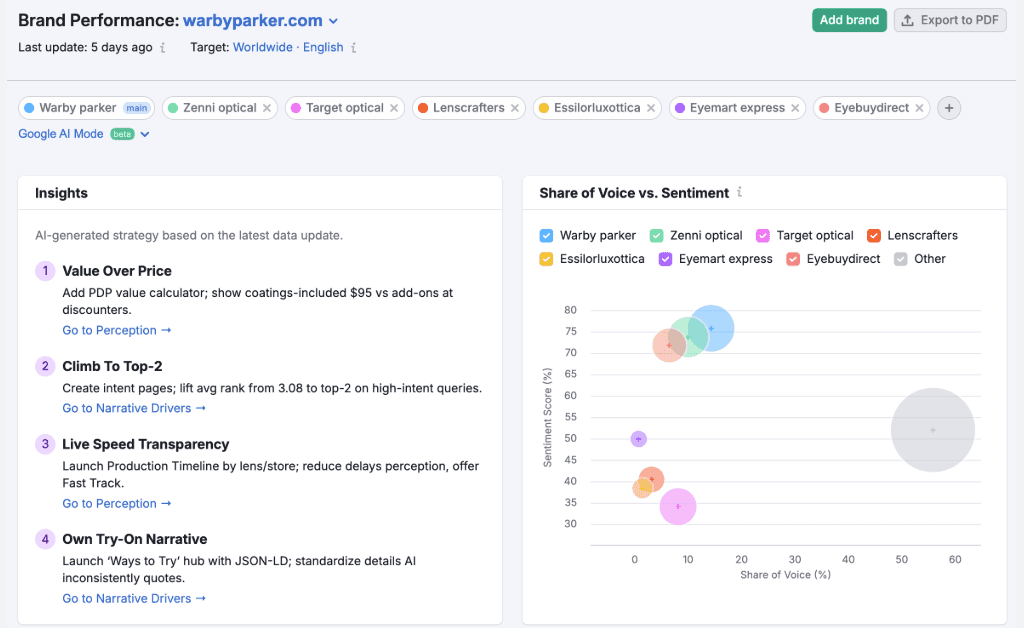
Semrush shows how your brand appears in AI-generated answers and how that compares to competitors. It tracks visibility across platforms and rolls it up into metrics such as share of voice, narrative, sentiment, mentions, and cited sources. It also lets teams monitor a custom set of prompts and keywords over time, enabling them to review AI visibility alongside traditional search performance rather than in a separate workflow.
Semrush connects AI visibility data to existing Semrush features, such as Position Tracking, Domain Overview, AI Overview reporting, and site auditing, making it easier to operationalize AEO and SEO strategies together. The tradeoff is that this is still a visibility and optimization product, not an attribution layer.
Best for: Teams already using Semrush that want AI visibility, competitor tracking, and cited-source analysis inside an existing SEO workflow.
Review: “We’ve been playing around with AEO since the second half of last year, and Semrush has been a huge help for us. It’s been great to see their AEO functionality actively evolving alongside our own skills as we figure out what “proper” AEO actually looks like in practice.”
SEOTalos
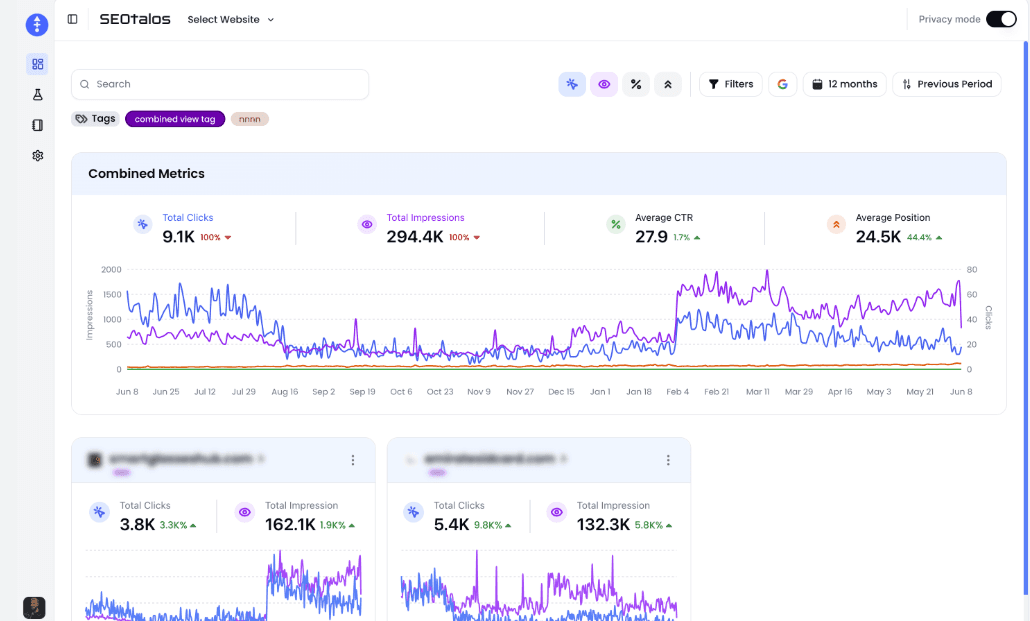
SEOTalos is built around mapping prompts to brand inclusion, giving teams a structured way to monitor which queries lead to recommendations. It allows users to define a set of tracked prompts and observe how visibility changes across those queries as content or market conditions evolve. Its value lies in consistency. It provides a repeatable way to track performance across a known set of prompts. However, it does not extend beyond that scope. There is no broader visibility analysis, no competitive benchmarking at scale, and no connection to downstream outcomes such as traffic or conversions.
Best for: Teams that need structured, repeatable prompt tracking
The Shift from Visibility to Performance
The shift in how decisions are made is already happening. Buyers are no longer relying solely on search results; they are asking AI systems for recommendations and making choices based on the answers they receive. That changes what visibility means. It’s no longer about where you rank, but whether you are included in the response at all.
Most GEO tools help teams understand that visibility, but to operate effectively, teams need to go further. That means understanding how presence in AI-generated answers translates into traffic, conversions, and revenue, and having a clear path to improve it.
Limy allows teams to track how brands appear across AI systems, understand which prompts and topics drive real outcomes, and translate those insights into actionable improvements. Instead of stopping at visibility, it connects performance to measurable business results. As AI systems continue to shape how buyers discover and evaluate products, the ability to understand and act on that channel will define how competitive your brand remains.
Book a demo to see how Limy can help you close your AI visibility gaps and turn them into measurable growth.
FAQs
What is a generative engine optimization (GEO) tool?
A GEO tool tracks how your brand appears in AI-generated answers from ChatGPT, Gemini, Perplexity, and AI Overviews. It runs prompts, captures the responses, and reports on mentions, share of voice, competitors, and cited sources.
How are GEO tools different from traditional analytics tools?
Traditional analytics measure clicks and rankings, which depend on someone visiting your site. GEO tools measure what happens before the visit: whether your brand is even named in the AI answer.
Can GEO tools replace SEO tools?
No, they complement each other. Strong SEO foundations still decide whether AI systems see you as credible; GEO measures whether you are actually selected and recommended in AI answers.
Which GEO tool is best for teams that need revenue attribution?
Limy. Most GEO tools stop at visibility, while Limy works at the infrastructure level, tracking real agent behavior and connecting prompts through to conversions and revenue.
Do GEO tools work across all major AI platforms?
Most track the major answer engines like ChatGPT, Gemini, Perplexity, and AI Overviews, but coverage varies by tool. Always confirm which platforms a tool monitors before choosing it.
What is share of voice in GEO?
It measures how often your brand appears in AI answers across a set of prompts, compared to competitors. A higher share of voice means you are recommended more often in your category.
Most Viewed Articles


