




Abstract: AI visibility optimization helps brands improve how they are understood, cited, and recommended across AI-powered search experiences. Visibility alone is no longer enough. The goal is to increase the frequency of recommendations, strengthen the competitive position, and connect AI-driven discovery directly to revenue.
Top 8 AI visibility optimization best practices:
Strengthen Entity and Category Clarity
Create Comparison and Evaluation Content
Improve Citation Authority and Third-Party Validation
Build Category Authority
Close Recommendation Gaps Using AI Visibility Data
Maintain Information Consistency Across the Web
Prioritize Optimization Based on Revenue Impact
Monitor AI Bot and Crawler Access to Strategic Pages
Showing up is not the same as being recommended. Many brands already appear in AI-generated answers, yet competitors continue to win the recommendations that influence buying decisions. The difference often has little to do with content volume or traditional SEO performance. It comes down to how AI systems interpret your category, evaluate your credibility, compare you to alternatives, and decide whether you're relevant to a specific prompt.
If you are responsible for growth, SEO, digital acquisition, or performance marketing, this means AI visibility must now be managed as a competitive performance channel.
79% of UK retailers believe AI agents will become essential to staying competitive. As AI increasingly influences product discovery and evaluation, AI visibility optimization is becoming a critical discipline for improving recommendation frequency and competitive position.
What Is AI Visibility Optimization?
AI visibility refers to how often and how accurately a brand appears across AI-generated answers, recommendations, summaries, shopping journeys, and research experiences. This includes platforms such as ChatGPT, Gemini, Claude, Perplexity, and Google AI Overviews.
AI visibility optimization is the process of increasing the likelihood that AI systems discover, understand, trust, and recommend your brand when users ask relevant questions. While visibility is the outcome, optimization is the process that determines whether your brand becomes a recommendation in the first place.
A mention alone rarely creates business value. Many brands appear in AI-generated answers without ever becoming the preferred option, while the brands generating the strongest commercial results consistently earn recommendation share during high-intent buying journeys.
Modern AI systems evaluate information differently from traditional search engines. Rather than simply matching keywords to queries, they synthesize information from websites, reviews, industry publications, and countless third-party sources to validate business context. Increasingly, these systems act as evaluators on behalf of buyers, determining which brands best answer a user's question and deserve to be recommended.
The goal, therefore, is not simply to be included in AI-generated answers but to become the brand AI systems choose when buyers are actively researching and making decisions.
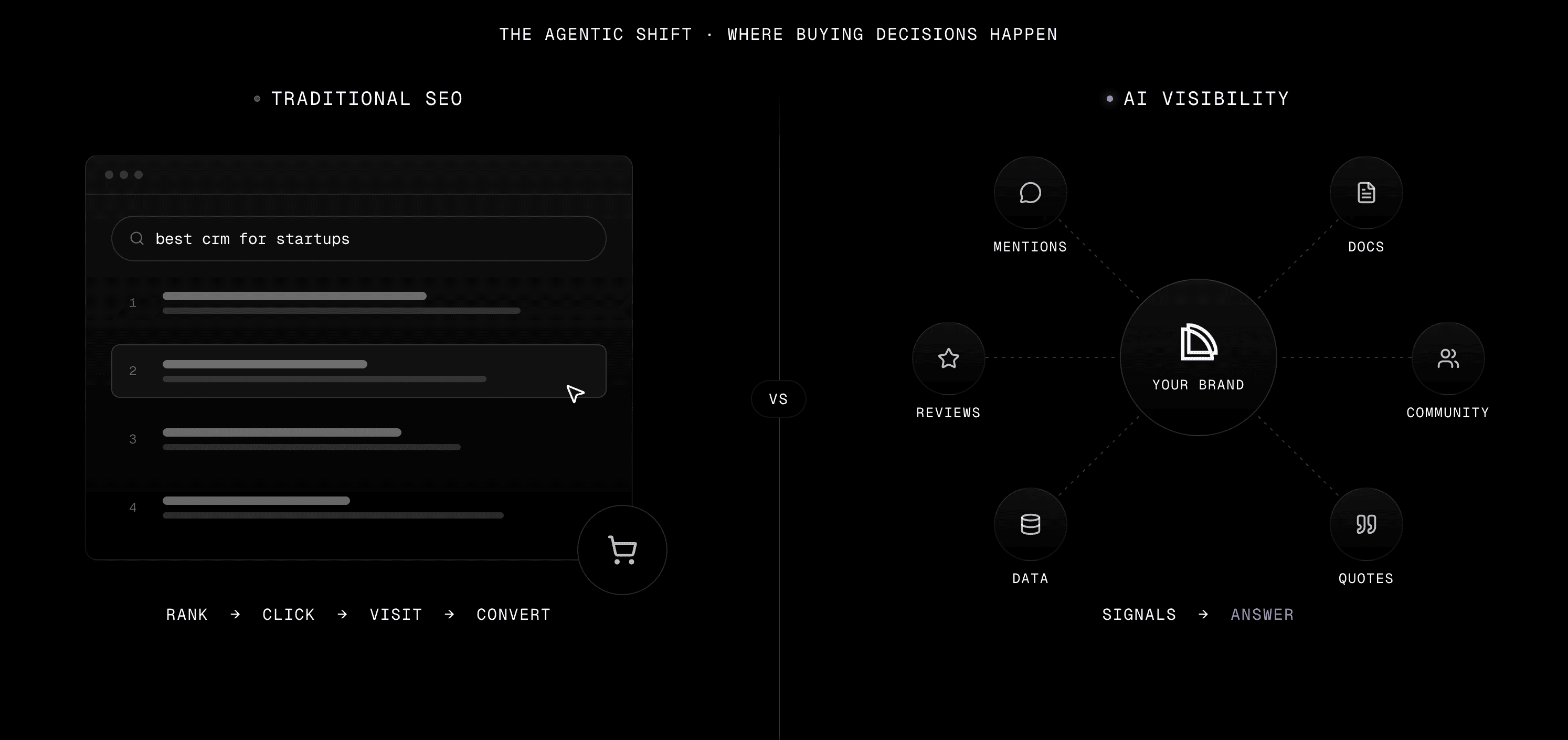
8 Best Practices for AI Visibility Optimization
1. Strengthen Entity and Category Clarity
One of the most common AI visibility issues is brands describing themselves inconsistently across websites and other marketing channels. Humans can often interpret those differences, but AI systems are less forgiving and won’t recommend a company they do not fully understand.
Clearly communicate what your company does, which category it belongs to, who it serves, which problems it solves, and how it differs from competitors. Start by reviewing the core product, solution, industry, and company pages.
Ensure category definitions are explicit rather than implied. Standardize positioning language across the website and supporting marketing assets, including social media channels. This consistency helps AI systems connect your product to the right categories, audiences, and recommendation opportunities.
The clearer your category position, the easier it becomes for AI platforms to associate your product with relevant buying journeys, while helping protect your brand from inaccurate categorization and positioning.
2. Create Comparison and Evaluation Content
Many of the prompts that influence buying decisions are not informational but comparative. They often mirror buyer intent keywords such as “best,” “pricing,” “alternatives,” “use cases,” and competitor comparison queries.
What are the best CRM platforms?
HubSpot vs Salesforce
Alternatives to Shopify
Best cybersecurity platform for SaaS companies
When AI systems generate answers to these prompts, they often reference content specifically designed to support evaluation and decision-making. That’s why it’s critical to have bottom-of-the-funnel content available online, including competitor comparison pages, buyer's guides, feature comparison content, evaluation frameworks, and objection-handling resources. This content helps AI systems understand how your solution fits within the competitive landscape and provides critical context during recommendation generation.

3. Improve Citation Authority and Third-Party Validation
Recommendations are often influenced by external content, such as analyst reports, review platforms, industry publications, customer testimonials, directories, or partner websites. These external signals help AI systems determine credibility and trustworthiness. If competitors consistently receive mentions in authoritative sources while your brand does not, the frequency of recommendations can suffer regardless of your website's quality.
Identify the third-party sources that already influence your category. Search for your target keywords, competitor comparisons, and "best X" lists to see which publications, review platforms, and directories appear repeatedly. Then audit where your competitors are present, and your brand is missing. Next, build a plan to close those gaps:
Claim and update directory listings
Strengthen review generation programs
Pitch industry publications with proprietary data or expert commentary
Pursue analyst briefings
Create partner content that earns citations from trusted domains.
If competitors appear in comparison articles or buying guides, look for opportunities to contribute insights, customer stories, or research that increases your likelihood of being referenced alongside them. While your team can do much of this work manually, understanding which citations influence AI recommendations and where competitors are outperforming you often requires an advanced AI visibility tool.
4. Build Category Authority
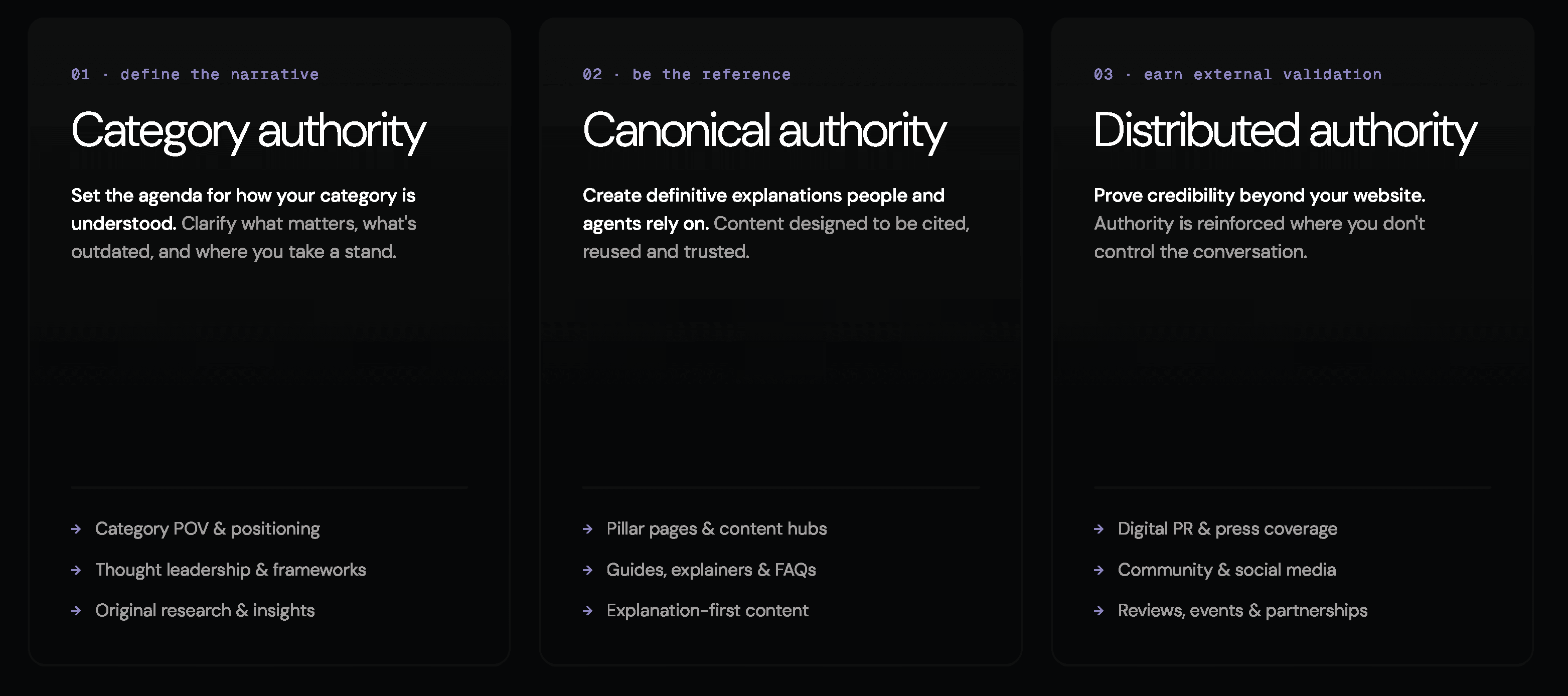
AI recommendations are heavily influenced by topical authority. Brands that consistently demonstrate expertise across a category are significantly more likely to appear when users ask category-level questions, explore solutions, or seek recommendations.
Start by mapping the core questions buyers ask before purchasing, then create dedicated category pages, use-case content, industry pages, and thought leadership that answers those questions from multiple angles.
The objective is to build the most relevant and authoritative body of information around the topics that matter most to your audience. Over time, AI systems begin associating brands with specific categories, industries, use cases, and buying decisions, which directly influences recommendation eligibility and visibility within high-value prompts.
5. Close Recommendation Gaps Using AI Visibility Data
Many brands continue publishing content without understanding why competitors consistently win recommendations. As a result, teams often invest heavily in content production while missing the underlying factors that influence AI-generated answers.
Optimization should start with AI strategic visibility. AI visibility data can reveal monitored prompt categories, buying questions, and recommendation patterns where your brand is underrepresented or absent altogether. These opportunities are often difficult to identify manually because they emerge from thousands of real-world AI interactions rather than a predefined keyword list.
Look for patterns across industries, customer segments, product categories, use cases, and evaluation criteria to create content that addresses the questions your buyers are already asking AI platforms.
Limy tracks prompt-level visibility, recommendation frequency, Share of Model, citation influence, and competitor inclusion across major AI search platforms. Teams can identify the exact prompts where competitors are winning, understand why those recommendations occur, and prioritize the highest-value opportunities.
Unlike traditional platforms that stop at reporting, Limy's Recommendations Engine transforms data into an execution plan. The platform identifies citation gaps, positioning weaknesses, content opportunities, and recommendation opportunities, then prioritizes them based on expected business impact. Instead of guessing which optimization efforts will move the needle, teams can focus resources on the actions most likely to improve competitive position and generate revenue.
6. Maintain Information Consistency Across the Web
Most organizations update their website regularly but rarely review the dozens of external profiles that describe their business. Over time, it’s natural that those descriptions become outdated or inconsistent.
Create a quarterly audit process for the sources most likely to influence buyer research and AI discovery. If your website positions you as an AI visibility platform while review sites categorize you as an SEO tool, AI systems receive conflicting signals about where your brand belongs. Assign ownership of these profiles to a specific team, maintain a master version of your positioning and category definitions, and update external sources whenever messaging changes.
7. Prioritize Optimization Based on Revenue Impact
Different prompts carry different commercial value. A discovery-stage prompt may help build awareness, while an evaluation-stage prompt can influence the pipeline, and a decision-stage prompt can directly impact purchasing decisions. Prioritization should focus on the prompt categories most closely tied to commercial intent.
Most platforms can tell you whether your brand appears in AI-generated answers. Still, they struggle to connect that visibility to the outcomes marketing leaders actually care about: traffic, leads, opportunities, customers, and revenue. AI referral analytics help teams understand which AI engines, prompts, and recommendation paths drive visits, leads, and revenue, providing a far clearer view of AI search performance than traditional analytics platforms can.
Limy connects the entire journey from Prompt → Recommendation → Interaction → Conversion. Teams can identify which prompts, citation sources, and content assets contribute most to visibility, recommendations, and downstream business outcomes, making it easier to prioritize future optimization efforts.
8. Monitor AI Bot and Crawler Access to Strategic Pages
AI agents regularly visit websites to gather information and extract content that may later influence recommendations. Yet most marketing teams don’t know which agents access which pages or what information they consume.
If you're managing this manually, start by reviewing server or CDN logs to identify AI crawlers and user-triggered fetchers such as GPTBot, OAI-SearchBot, ChatGPT-User, ClaudeBot, Claude-SearchBot, Claude-User, PerplexityBot, Perplexity-User, Googlebot, GoogleOther, and relevant Google control tokens such as Google-Extended.
Compare crawler activity against the pages that matter most to your business, including product, pricing, solution, comparison, category, documentation, and proof pages. If those pages receive little or no AI crawler activity, investigate potential blockers such as robots.txt directives, meta robots tags, indexability settings, CDN or WAF rules, access restrictions, rendering issues, weak internal linking, missing structured data, or important content that is not available in visible, crawlable text. Crawler access improves eligibility and extractability, but it does not guarantee that AI systems will cite, summarize, or recommend a page.
For most organizations, however, this quickly becomes difficult to manage at scale. Limy provides direct visibility into AI bot and crawler activity, helping teams understand which agents access their site, which pages influence AI-driven discovery, and where technical barriers may be limiting visibility. Teams can make optimization decisions based on real agent behavior rather than inferred signals.
AI Visibility Optimization Checklist
Clarify category definitions across product, solution, and industry pages
Standardize positioning and terminology across all channels
Remove conflicting company descriptions
Create authoritative category and use-case content
Build competitor comparison pages
Create alternative pages for key competitors
Expand evaluation-focused content
Build content around adjacent use cases and high-intent prompt themes
Strengthen reviews, proof points, and case studies
Increase visibility in trusted publications and directories
Improve internal linking between strategic pages
Monitor recommendation share across key prompts
Track competitor inclusion and recommendation frequency
Identify citation gaps influencing recommendations
Update pages that are frequently cited or likely to influence AI-generated answers
Audit AI crawler access to important pages
Ensure strategic content is available in crawlable text
Resolve crawlability and extraction issues
Refresh high-value content regularly
Focus on high-intent prompt categories
Prioritize opportunities tied to the pipeline and revenue
Become the Brand AI Chooses
AI visibility optimization is ultimately about increasing the likelihood that AI systems recommend your brand when buyers are making decisions. The organizations pulling ahead are not simply monitoring visibility; they are strengthening category authority, improving recommendation frequency, closing competitive gaps, and focusing their efforts on the prompts that drive real business outcomes. Most platforms can tell you whether your brand appears, but they stop there.
As the marketing stack for the agentic web, Limy turns AI search into a measurable revenue channel. It helps brands understand how AI agents discover and evaluate them, identify the highest-impact opportunities to improve performance, and connect every optimization back to measurable business outcomes.
See how your brand performs across AI search, uncover the recommendation opportunities competitors are winning, and identify which optimizations are most likely to drive revenue. Start now to turn AI search into a measurable growth channel.
FAQs
What is AI visibility optimization?
It is the process of making AI engines more likely to discover, understand, trust, and recommend your brand when buyers ask relevant questions. Visibility is the outcome; optimization is the work that turns a mention into a recommendation.
What is the difference between appearing in AI answers and being recommended?
Appearing means you are mentioned. Being recommended means the answer positions you as the preferred choice. Many brands show up often without ever being the pick, and recommendations are what influence buying decisions.
How do I improve how AI engines recommend my brand?
Make your category and positioning consistent everywhere, create comparison and evaluation content, and earn citations in the third-party sources AI engines trust. Then use visibility data to find the exact prompts where competitors win and fix those first.
Why do competitors get recommended when my content is good?
Recommendations are often shaped by external sources like reviews, publications, and directories, not just your site. If competitors appear in those trusted sources and you do not, your recommendation frequency suffers regardless of your content quality.
Which prompts should I prioritize optimizing for?
The ones tied to commercial intent, especially evaluation and decision-stage prompts like "best," "alternatives," "vs," and pricing. Those influence pipeline and revenue far more than broad informational queries.
How do AI crawlers affect my visibility?
If AI crawlers cannot reach your key pages, those pages cannot influence recommendations. Check for blockers like robots.txt rules, indexability settings, rendering issues, and content that is not in crawlable text. Access improves eligibility, but it does not guarantee a recommendation.
Most Viewed Articles


